
Search engine optimisation for Irish sites, delivered remotely
Search engine optimisation (SEO) is one of the few services that loses nothing by being delivered from another country. The work happens in your site, in your Search Console property and in your analytics, and none of those care where the person doing it sits. We are a studio in Timișoara, Romania, inside the EU, we work with Irish clients remotely, and we invoice in euro.

This page is about the work itself: what gets done in a month, what we can influence, what we cannot, and how you check any of it without taking our word for it. The figures live on a separate page, linked further down.
What the monthly work covers
An engagement with us has four moving parts, and each one produces something you can open and read.
Technical work on the site itself. Indexing, crawling, speed, structure, redirects, structured data, and language tags if you sell into more than one country.
Page and intent mapping. Deciding which page answers which search, so two of your own pages stop competing for the same query. On most sites we take over, this is the fastest improvement available.
Content. Rewriting the pages you already have before adding new ones, then writing the ones that are missing. A service that does not have a page cannot be found, and a page aimed at nothing in particular is found for nothing in particular.
Measurement and a written report, built from your own data, showing what was touched and what moved.
Outside the monthly fee unless the quote says otherwise: design and new page templates, moving platform, paid advertising, photography and translation.
Technical SEO, the part that travels best across borders
Technical work needs access, not proximity. Give us the site and the Search Console property and the distance stops mattering.
The first pass is always the same. What Google actually has indexed, and whether it matches what you think is on the site. Which pages return errors, redirect in chains, or exist twice at two addresses. How quickly the pages that matter load on a mid range phone, the device most enquiries arrive from. Whether titles and descriptions were written or generated. Whether the structured data describes the business honestly, opening hours and service areas included.
Then the fixes, ordered by what changes the outcome rather than by what is quick to tick off. A site with three hundred pages indexed that should have forty has a different first job from a site that loads in six seconds.
Migrations are the case where technical work earns its fee most visibly. Moving platform, changing domain or restructuring URLs without a redirect map is the most reliable way to lose traffic that took years to build. We did exactly this move for CJM Bathrooms in Ireland, off WordPress onto custom code, with the DNS cutover planned in advance rather than improvised.
On-page work and content structure
On-page work is where most Irish sites we look at have the largest gap, and it is rarely a writing problem.
The common pattern is one page called Services listing eight things the business does. Search engines have nothing to rank it for, because it is about eight subjects at once, and a customer looking for one of them has to hunt for the right paragraph. Splitting it into a page per service usually changes more than any technical fix on the same site.
After the split comes the boring part that decides results. One subject per page. A title that says what the page is rather than repeating the company name. Headings in an order a person could follow out loud. The question a customer actually asks, answered in the first paragraph rather than in a brochure. Internal links from the general page to the specific one.
Prices, or at least ranges, wherever you can publish them. Visitors who find no figure do not ring to ask. They leave and ask somebody who published one.
And the content nobody wants to write: what you do not do, which area you cover, and how long things take.
Ecommerce SEO: categories, filters and product pages that rank
On a shop, most of the search traffic that matters lands on category pages, not on the homepage. So that is where the work starts: one category per real buying intent, a short piece of text on each that says what the range is and who it suits, and a heading structure a crawler can read without opening the filters.
Filters are where shops usually waste crawl budget. Every combination of size, colour and brand can generate its own address, thousands of near-identical pages competing with the category itself. We decide which combinations deserve an indexable page, block the rest, and keep the canonical on the category.
Product pages get a title with the product name and the attribute people search for, a description that is not the manufacturer's paragraph copied across forty shops, structured data for price and availability, and a sensible answer for what happens to the address when the product goes out of stock. Delivery and returns copy written for the Republic helps too, since it is what a buyer checks before paying.
Local search in Ireland, and what we can and cannot influence
Worth being direct here, because this is where cross border suppliers usually oversell.
We have no address in Ireland and no Google Business Profile there. So we cannot promise you a position in the local map results, and we cannot make a search that asks for a supplier nearby return a supplier who is not.
What we can do is everything that sits on property you own. Your own Google Business Profile: categories, services, opening hours, photographs, questions and posts, maintained with your details rather than ours. Your name, address and phone number written identically everywhere, because inconsistency is the most common reason a profile underperforms. A page for each area you genuinely serve, with real content about working there. LocalBusiness structured data that matches the profile. And a routine for asking customers for reviews and answering the ones you get.
That combination is what moves local visibility for a business with one location. It is slower than a promise and it is the honest version of it.
Reporting: Search Console figures, not screenshots
Every number we report comes from a property you own and can open yourself, which means you can check us without asking us first.
The monthly report shows impressions and clicks by query, average position by query and by page against the previous month, queries that appeared for the first time, indexing and coverage errors, and a plain list of what we changed and when.
Two things are deliberately absent. No dashboard aggregating tools you have no access to. And no ranking screenshot, because a position taken on one machine in one town on one day is not a measurement.
We also write down what did not work. A page that was rewritten and lost ground is more useful to the next decision than a paragraph explaining the industry is competitive.
You keep the reports, the property and the history if you stop working with us. None of it is held in an account that belongs to the agency.
SEO for AI search: what changes for an Irish site
Two separate questions get mixed here, so we will split them.
The first is what AI does to results. Assistants and AI summaries increasingly answer the question on the results page, so there are fewer clicks on queries with a simple factual answer and roughly unchanged behaviour where somebody is choosing a supplier. The work that makes a page usable as a source is the work that already made it rank: a clear subject, an answer near the top, facts that can be checked, and structured data that describes the page correctly. There is no separate product to buy for this.
The second is what AI does inside the work. We use it where it saves time without deciding anything: sorting large query exports, first drafts of repetitive descriptions, spotting patterns in a crawl. We do not publish generated text as it comes out, because pages written that way read like every other page written that way, and the person who eventually reads it can tell.
If a supplier sells you an AI SEO package, ask what is in it that is not already in a normal engagement.
Dublin, Cork and the rest of the country
We work across the Republic of Ireland: Dublin, Cork, Galway and Limerick, and counties Carlow, Donegal, Kildare, Meath, Wexford and Kerry. The work is remote, so where you are changes neither the price nor the schedule.
Most of what reaches us from Ireland is trades and home services, which is where our portfolio is strongest. The Irish project is CJM Bathrooms, a bathroom renovation business. In Romania we have worked on construction, building materials, heating and ventilation and renewable energy sites: the same commercial pattern, a handful of services, an area covered, and a customer comparing two or three suppliers before ringing one.
This page is written for the Republic, and the prices are in euro. If your business is in Northern Ireland, say so early, because the currency and the invoicing are different.
Pricing, and where to find it
There is no figure on this page, and that is on purpose. A monthly fee only means something next to a scope, and the scope depends on how many services you sell, what state the site is in, and whether anybody is competing with you for the same searches.
What we can say is how the fee behaves. It is invoiced in euro, monthly, and the amount on the quote is the amount on the invoice. The scope is written down before the first month, and anything outside it is quoted rather than absorbed and mentioned later.
The way the fee is built, what a retainer includes and what an audit costs are all set out in our SEO rates, month by month.
Related pages: SEO rates in Ireland, month by month
Questions before you sign an SEO contract
Can you promise us a position in Google?
No. Nobody controls the ranking, and a supplier who promises one is selling something they do not own. What we commit to is a written scope, work delivered every month, and a report from your own data.
How long before anything shows?
Technical fixes can show within weeks. New and rewritten content takes months to settle. On a site with a difficult history, the first clear movement usually appears somewhere between month three and month six.
Do you work on sites you did not build?
Yes, provided we get access and the platform lets us change titles, structure and content. Some do not. We check that before you pay for a month, not after.
What happens if we stop?
Everything done so far stays on your site and belongs to you, along with the accounts and the reports. What stops is new production and monitoring.
Do you sell links?
No. We do not buy them, we do not place them on sites that exist only to sell them, and we do not run exchange schemes. If a quote you are comparing includes a monthly link quota, ask where they come from.
Do we need SEO or a new site first?
Sometimes the answer is a new site, and we will say so. Paying every month for content on a site that cannot be crawled properly means paying for the same problem twice.
Is there a free way to see where we stand?
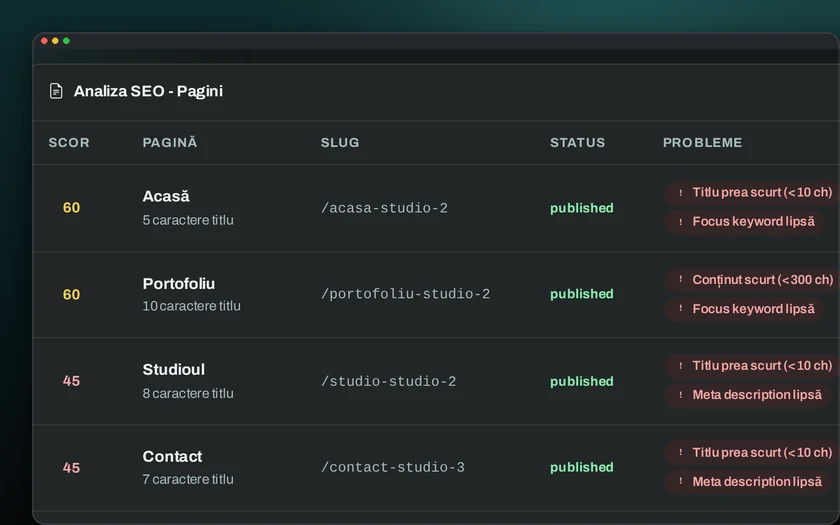
Yes. There is an automated scan on our site: 27 checks across indexing, meta tags, speed and structured data, with a score on the spot. It is a scan, not an audit.
How do we start?
Send the site address and the searches you want to be found for to [email protected], or call +40 770 129 502. You get a scope and a price in writing, and the first look costs nothing.
How we work
- 01Brief and written quoteWe discuss your goals and you get the price and deadline in writing.
- 02Design and developmentYou see every stage in the panel and approve it before launch.
- 03Launch and growthWe publish, measure and improve on real data.
Ready to start your project?
Let us bring your vision to life with a tailored digital solution.